how to hire digital marketing consultant
March 20, 2026
PageSpeed Insights guide
April 20, 2026
Why Your Digital Marketing Strategy is Failing: The Hidden Metrics You’re Ignoring
73% of marketing budgets are allocated based on last-click attribution models that miss 60% of the actual customer journey
Marketing Attribution Research Institute
I’ve watched hundreds of marketing teams burn through budgets chasing the wrong numbers. After 15 years running campaigns for everything from TiVo’s streaming push to scaling MOTA’s hardware sales by 400%, I can tell you the problem isn’t your creative or targeting.
It’s that you’re measuring the wrong shit.
The Vanity Metrics Trap That’s Killing Your ROI
Look, I get it. Impressions feel good. Click-through rates make pretty charts for executive dashboards. But here’s what I learned managing Amazon campaigns at Xperi with a 10% ACoS target: the metrics that matter are buried three layers deep in your analytics.
Most teams I audit are obsessing over:
- Social media reach and engagement
- Website traffic volume
- Email open rates
- Brand awareness lift
Meanwhile, they can’t tell me their customer acquisition cost by channel, lifetime value ratios, or which touchpoints actually drive revenue.
On r/marketing, the frustration is real. One agency owner posted: “Client wants more ‘brand awareness’ but won’t define what that means or how it connects to sales.” That’s the disconnect right there.
The Hidden Attribution Crisis
According to recent analysis by the Digital Marketing Institute, over 80% of conversions involve multiple touchpoints across different devices and channels. Yet most attribution models still rely on outdated last-click methodology.
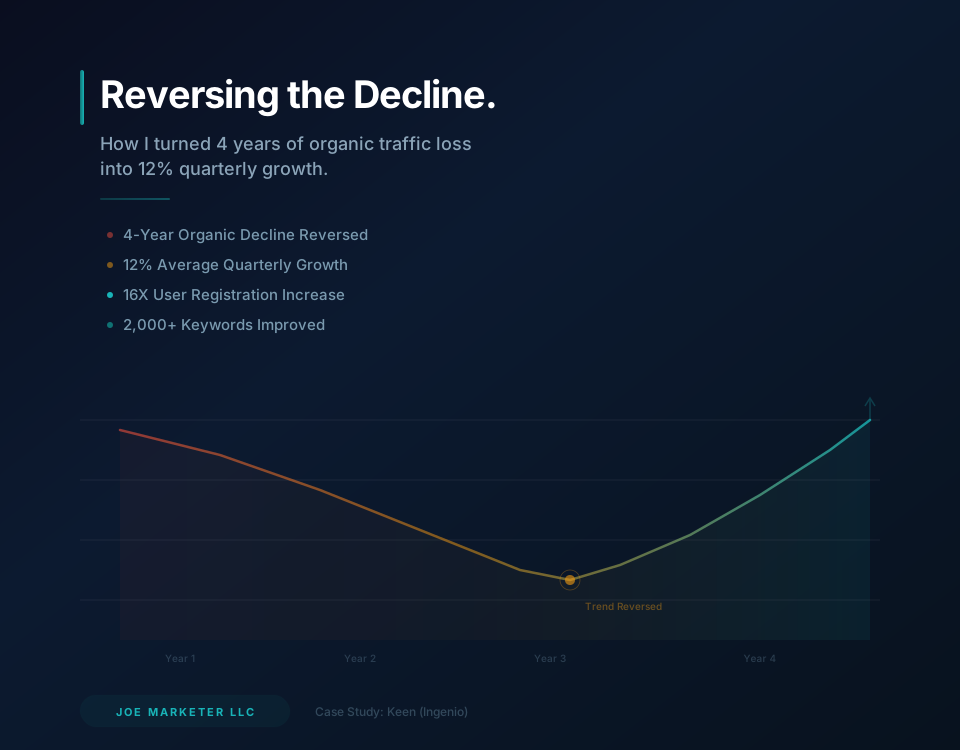
I saw this firsthand at Ingenio when we were trying to reverse a YoY organic decline. The previous team was optimizing for search rankings while ignoring how organic traffic actually converted. Turns out, organic visitors had a 3x higher lifetime value but took 40% longer to convert.
We shifted budget allocation based on true revenue attribution. Result? 16x increase in qualified registrations within six months.
Multi-Touch Attribution That Actually Works
Here’s what I track now for every client:
Revenue-weighted touchpoint analysis: Not just which channels get credit, but how much revenue each interaction influences over the full customer lifecycle.
Cross-device journey mapping: Mobile research to desktop purchase patterns reveal optimization opportunities most teams miss completely.
Assisted conversion ratios: The channels that don’t get last-click credit but drive the highest-value customers.
Why Customer Lifetime Value Changes Everything
Most marketing teams optimize for immediate conversions. But when I analyze the data, the highest-converting campaigns often attract the lowest-value customers.
At MOTA, our initial Facebook campaigns had impressive conversion rates. Terrible retention. The customers acquired through search took longer to convert but had 2.8x higher lifetime value and 65% better retention rates.
This isn’t just about adjusting your metrics. It fundamentally changes how you allocate budget, design creative, and structure campaigns.
The LTV Calculation Nobody’s Doing
Standard LTV formulas miss crucial factors:
- Referral value from word-of-mouth
- Cross-sell and upsell propensity by acquisition channel
- Support cost variations between customer segments
- Seasonal purchase pattern differences
When you factor these in, your channel performance rankings flip completely.
The Contrarian Take: Sometimes Lower Performance Metrics Mean Better Results
Here’s something that’ll mess with your head: I’ve seen campaigns with lower click-through rates and higher cost-per-click outperform “better” campaigns by 300% in terms of revenue impact.
Why? Because generic, broad-appeal creative attracts tire-kickers. Specific, niche-focused creative that speaks directly to your ideal customer naturally filters out low-intent traffic.
A B2B software client was frustrated their LinkedIn ads had a 0.8% CTR compared to industry benchmarks of 2.1%. But their cost-per-qualified-lead was 60% lower and those leads converted at 3x the rate.
Sometimes “worse” performance metrics indicate better targeting.
Cross-Channel Engagement Patterns You’re Missing
The biggest revelation in my recent campaign analysis: customers who engage across multiple channels have dramatically different behavior patterns than single-channel users.
Email subscribers who also follow your social accounts convert 40% faster and have 25% higher order values. But most attribution models treat these as separate metrics instead of recognizing the compound effect.
The Sequential Campaign Strategy
Instead of running parallel campaigns across channels, I now design sequential engagement flows:
Phase 1: Awareness content optimized for specific pain points
Phase 2: Educational content for engaged prospects
Phase 3: Social proof and conversion-focused messaging
Phase 4: Retention and expansion campaigns
Each phase feeds into the next, and the metrics reflect cumulative impact rather than individual channel performance.
Advanced Measurement Frameworks That Actually Drive Growth
After testing dozens of attribution models, here’s what consistently predicts actual business growth:
The Revenue Velocity Score
This combines conversion rate, average order value, and time-to-conversion into a single metric that reflects how efficiently each channel drives revenue.
Formula: (Conversion Rate × AOV) ÷ Average Days to Convert
Engagement Quality Index
Instead of measuring engagement volume, track engagement depth:
- Time spent with content (not just page views)
- Return visit patterns within 30 days
- Cross-channel interaction frequency
- Content consumption progression
Predictive Lifetime Value Modeling
Use first-purchase behavior, acquisition channel, and early engagement patterns to predict long-term customer value before you have historical data.
This lets you optimize for future value instead of just immediate conversions.
Implementation Strategy: Making the Switch Without Losing Your Mind
Look, I know this seems overwhelming. You can’t flip your entire measurement strategy overnight without causing chaos.
Here’s how I roll this out with clients:
Month 1: Set up parallel tracking. Keep existing dashboards while building new attribution models.
Month 2: Identify the biggest disconnects between current metrics and revenue impact.
Month 3: Run small test campaigns optimized for new metrics while maintaining baseline performance.
Months 4-6: Gradually shift budget allocation based on insights from improved attribution.
The key is proving the new approach works before asking stakeholders to abandon familiar metrics.
FAQ
How do you convince executives to change measurement frameworks they’re comfortable with?
Show them the money. I create side-by-side reports showing current metrics vs. revenue impact for the same campaigns. When they see campaigns with “poor” traditional metrics driving actual business growth, the conversation changes fast.
What’s the minimum viable setup for better attribution tracking?
Start with Google Analytics 4’s data-driven attribution model, implement proper UTM tagging across all channels, and set up conversion value tracking. You can get 70% of the benefit with just these changes.
How often should you review and adjust attribution models?
I review monthly but only make major adjustments quarterly. Attribution patterns shift with seasonality, market conditions, and customer behavior changes, but too frequent changes make it impossible to identify actual trends.
What tools do you recommend for multi-touch attribution?
For smaller budgets, GA4 plus proper tagging covers most needs. Mid-market clients benefit from platforms like Attribution or Ruler Analytics. Enterprise accounts should consider Adobe Analytics or custom solutions integrated with their CRM.
How do you handle attribution for offline conversions?
Use unique promo codes, dedicated phone numbers for different campaigns, and post-purchase surveys asking how customers heard about you. Also set up proper CRM integration to track the full customer journey from first touch to final sale.
Joe Ma is a senior digital marketing consultant who has driven growth for TiVo/Xperi, Ingenio, and dozens of other brands. Get more marketing insights at joe-marketer.com or reach out at joe-marketer.com/contact/