
Is It a Bubble? Breakdown of Howard Marks’ Warning on AI and Market Hype
December 11, 2025
How I Reversed a 4-Year Organic Traffic Decline for a $100M+ Online Marketplace
March 19, 2026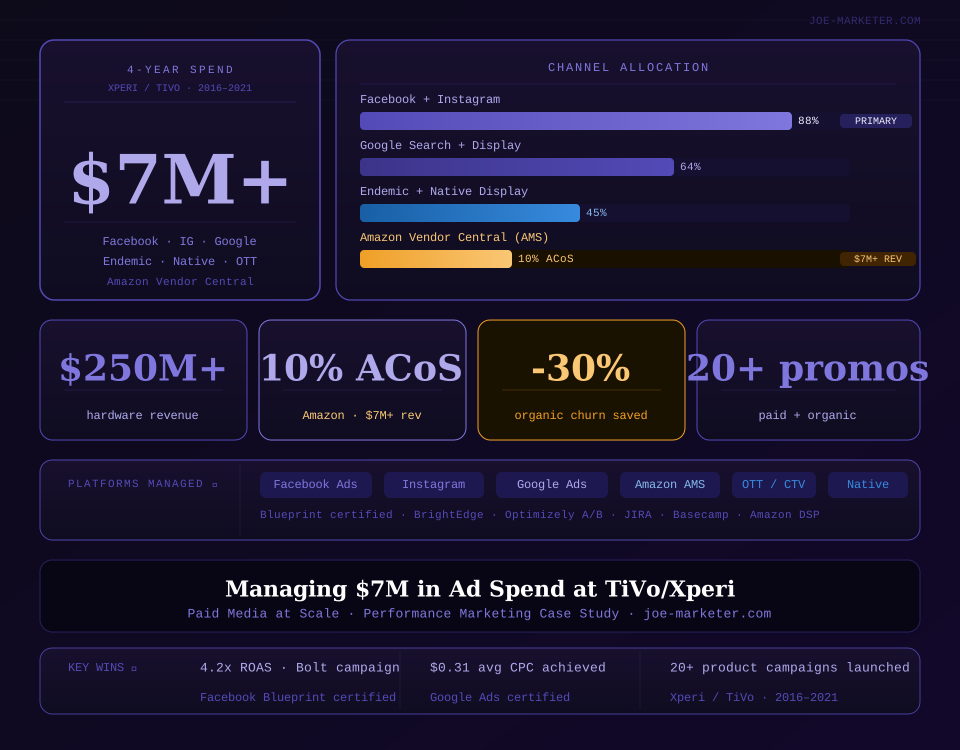
How I Managed Millions in Ad Spend at TiVo and What It Taught Me About Performance Marketing Meta Title: Managing Millions in Ad Spend at TiVo: Lessons in Performance Marketing (2026) Meta Description: I managed multi-million dollar paid media campaigns at TiVo driving their flagship Bolt product. Here’s what that experience taught me about scaling ad spend profitably. Target Keyword: managing large ad spend / performance marketing case study / paid media strategy Category: Case Studies Internal Links: → Google Ads B2B Strategy, TikTok Spark Ads, Marketing Metrics That Matter Word
Before I became the guy helping brands build SEO strategies and content engines, I was the guy spending other people’s money at scale. Specifically, TiVo’s money.
For those who don’t know, TiVo (now operating under Xperi) was the company that literally invented the DVR. They changed how America watched television. And for a stretch of my career, I was responsible for managing their paid media campaigns — we’re talking millions of dollars in annual ad spend — driving sales for their flagship product, the TiVo Bolt.
That experience shaped how I think about every marketing decision I make today. Here’s what I learned, and more importantly, what you can steal from it regardless of your budget size. The Scale Problem Nobody Talks About There’s a common misconception that managing a large budget is just like managing a small budget, except with more zeros. That’s wrong in every way that matters.
When you’re spending five or six figures monthly across Google Ads, display networks, social platforms, and programmatic channels, the complexity compounds in ways that aren’t obvious until you’re in it.
At smaller budgets, you can manually review every keyword, every ad group, every placement. You have time to A/B test everything methodically. At TiVo-level spend, you need systems. Automated rules, bid strategies, reporting dashboards, and a clear escalation framework for when campaigns start underperforming.
The first thing I did was build a campaign architecture that could scale. Most advertisers organize their campaigns by product or channel. I organized by customer intent stage — awareness, consideration, and conversion — then layered product targeting within each stage. This meant we could scale spend into any stage independently based on what the business needed at that moment.
Launching a new product like the Bolt? Pour budget into awareness and consideration. Holiday season approaching? Shift spend toward conversion campaigns with promotion-heavy creative. Post-holiday Q1 slowdown? Pull back to efficient brand defense campaigns. What Pushing the TiVo Bolt Taught Me About Product Marketing The TiVo Bolt was an interesting product challenge. By the time we were pushing it hard, streaming services were already eroding the traditional DVR market. We weren’t just competing against other hardware — we were competing against the narrative that DVRs were obsolete.
That forced us to think differently about messaging. We couldn’t just sell features (4K, skip mode, unified search). We had to sell the problem the Bolt solved: the chaos of managing multiple streaming services, cable, and recorded content across different apps and devices.
The campaigns that performed best weren’t the ones with the slickest creative or the highest bids. They were the ones with the tightest message-to-audience alignment. When we showed cord-cutting skeptics that TiVo Bolt unified everything into one interface — live TV, Netflix, Hulu, recorded shows — conversion rates jumped noticeably versus generic product ads.
This is a principle I still apply to every campaign I touch: your ad is only as good as its relevance to the specific person seeing it at the specific moment they see it. The Reporting Framework That Saved My Sanity When you’re accountable for millions in spend, you need to know exactly what’s working and what’s bleeding money — and you need to know it fast. I built a reporting framework at TiVo that I’ve carried with me to every role since.
Daily level: Cost, clicks, conversions, and cost-per-acquisition by campaign. Anomaly detection — any campaign deviating more than 20% from its trailing 7-day average gets flagged. This catches broken tracking, budget overdelivery, and sudden competitive shifts before they become expensive problems.
Weekly level: Channel-level performance trends, creative performance comparisons, audience segment analysis, and search query reports for paid search. Weekly is where you make optimization decisions — pausing underperformers, scaling winners, refreshing creative.
Monthly level: Full P&L attribution, channel mix analysis, new customer acquisition costs vs. lifetime value, and competitive share of voice. Monthly is where strategy decisions happen — budget reallocation, new channel tests, campaign architecture changes.
The mistake most marketers make is either over-reporting (checking stats hourly and making reactive changes) or under-reporting (reviewing performance quarterly and missing months of waste). The daily/weekly/monthly cadence gives you the right information at the right decision-making frequency. Budget Allocation: The 70/20/10 Rule At TiVo, I used a framework I still recommend to every client and employer I work with.
70% of budget goes to proven performers. These are the campaigns, channels, keywords, and audiences that have consistent, measurable ROI. You don’t touch these unless performance degrades. They’re your foundation.
20% goes to optimization experiments. This is where you test new ad formats, audience segments, bidding strategies, or landing page variants within proven channels. The risk is controlled because you’re experimenting within a channel you understand.
10% goes to completely new channels or tactics. At TiVo, this was where we tested things like connected TV advertising, YouTube pre-roll for product launches, and early programmatic display. Most of these experiments fail. But the ones that work eventually graduate to the 20% bucket, and then to the 70% bucket.
This framework prevents two failure modes: being too conservative (spending 100% on what worked last quarter while the market shifts underneath you) and being too aggressive (chasing every new platform while your core campaigns starve). Cross-Channel Attribution: The Honest Version I’m going to be real with you about something that most marketing case studies gloss over: attribution at scale is messy. At TiVo, we were running Google Ads, programmatic display, social media advertising, retail media, and email campaigns simultaneously. A customer might see a YouTube ad, click a Google search ad two weeks later, and convert through a retargeting banner a week after that.
Which channel gets credit for that sale? The answer depends entirely on which attribution model you use, and there is no attribution model that gives you the objectively “right” answer. Last-click attribution overvalues search and retargeting. First-click attribution overvalues awareness channels. Even data-driven attribution is just a more sophisticated guess.
What I learned to do instead was focus on incrementality. When we increased YouTube spend by 30% for a month, did total conversions increase at a profitable rate? When we paused display retargeting for two weeks, did conversion rates drop and by how much?
Incrementality testing isn’t as clean as a nice attribution dashboard, but it tells you something closer to the truth about what’s actually driving results versus what’s just touching the customer journey without changing their behavior. What This Means for You You probably don’t have TiVo-level budgets. That’s fine. The principles scale down perfectly.
If you’re spending $5K-$10K/month: Simplify your campaign architecture. Don’t spread across five channels. Pick two channels, organize by intent stage, and master them before expanding. Implement the daily/weekly/monthly reporting cadence even at small scale — it builds the discipline that makes you dangerous when budgets grow.
If you’re spending $10K-$50K/month: This is where the 70/20/10 framework starts paying off. You have enough budget to run meaningful experiments while keeping your core campaigns healthy. Start thinking about cross-channel measurement — even basic incrementality tests will teach you more about your marketing than any attribution dashboard.
If you’re spending $50K+/month: You need systems, not spreadsheets. Automated bidding rules, real-time dashboards, and a clear escalation framework. If you’re still manually managing campaigns at this spend level, you’re either a genius or you’re leaving performance on the table. Probably the second one.
The TiVo years taught me that great performance marketing isn’t about clever tricks or secret hacks. It’s about building repeatable systems, measuring honestly, and having the discipline to let data — not gut feelings — drive budget decisions.
That philosophy underlies everything I do today, whether I’m managing paid media campaigns or building organic content strategies. The channels change. The principles don’t.